10 Healthy Odia Foods You Should Eat More Often
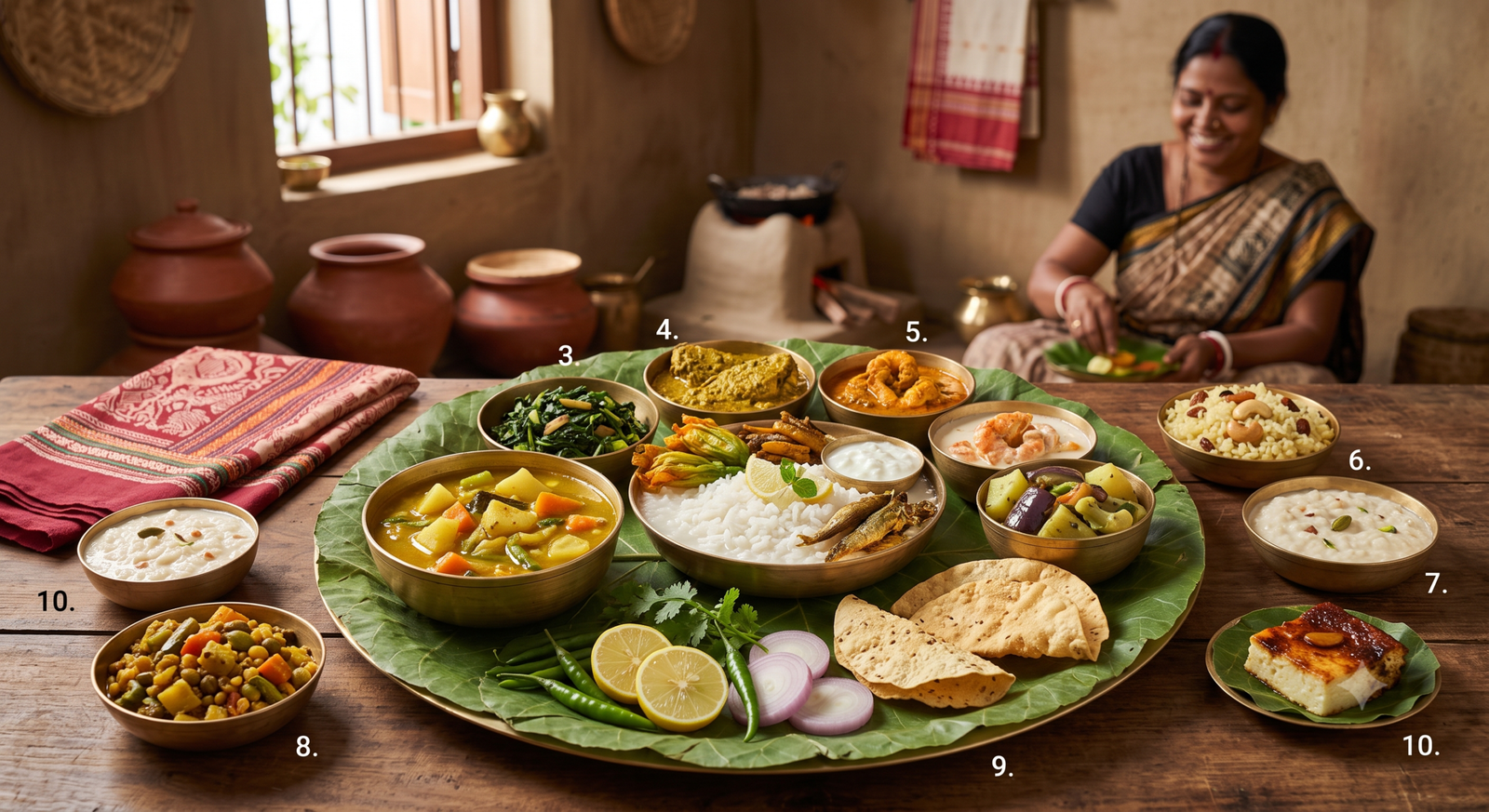
Traditional Odisha food is simple, seasonal and surprisingly nutritious. Here are 10 everyday Odia dishes worth bringing back to your plate more often.
When we think of Odia food, Pakhala, Dalma and different varieties of Pitha immediately come to mind. But Odisha’s traditional kitchen is much more than taste and nostalgia.
Long before terms like “balanced diet”, “whole foods” and “gut-friendly food” became popular on social media, Odia households were preparing meals using rice, millets, pulses, leafy vegetables, curd, seasonal vegetables and fermented foods.
Modern nutrition guidelines also encourage variety—whole grains or millets, pulses, vegetables, leafy greens, fruits and dairy or suitable alternatives—rather than depending on one so-called superfood.
So, instead of searching for expensive imported health foods, perhaps we should sometimes look inside our own kitchens.
Here are 10 traditional Odia foods that deserve a more regular place on our plates.
1. Pakhala Bhata
For an Odia, Pakhala is not simply food—it is an emotion.
Cooked rice is soaked in water and, in some versions, allowed to ferment before being eaten with curd, roasted vegetables, saga, badi or other side dishes.
Fermented Pakhala has also attracted scientific interest because fermentation changes the microbial and nutritional characteristics of rice water.
The healthiest approach is to keep the meal simple: Pakhala with curd, vegetables and saga rather than turning every side dish into a deep-fried accompaniment.
Healthy tip: Go easy on salt and fried side dishes.
2. Dalma
If one Odia dish deserves to be called a complete comfort food, Dalma would be a strong candidate.
Dalma combines dal with vegetables such as raw banana, pumpkin, papaya, brinjal, arbi and other seasonal produce.
The dal contributes plant protein, while the vegetables provide fibre and a range of vitamins and minerals.
It is also an easy way of adding several vegetables to one meal without complicated preparation.
Pair a bowl of Dalma with rice and some leafy vegetables and you have the foundation of a wonderfully simple home-cooked meal.
Healthy tip: Increase the vegetable-to-dal ratio and avoid excessive oil during tempering.
3. Mandia Jau
Before oats and imported breakfast cereals became fashionable, many parts of Odisha already had their own nutritious grain—Mandia or ragi.
Mandia has traditionally been consumed in several parts of Odisha, particularly in tribal regions.
Mandia Jau is generally prepared as a simple porridge and can make a filling breakfast or light meal.
Millets provide carbohydrates, fibre and several minerals. Finger millet is particularly valued for its naturally high calcium content.
Healthy tip: Keep added sugar or jaggery modest. A nutritious grain can quickly become a high-sugar breakfast if heavily sweetened.
4. Santula
Santula proves that healthy food doesn’t have to be complicated.
This traditional Odia preparation brings together vegetables such as papaya, pumpkin, brinjal, potato, beans and other seasonal produce.
It may be prepared with boiled vegetables and a light tempering, making it very different from rich restaurant-style vegetable curries.
Because several vegetables can be included in a single preparation, Santula is an excellent way of adding variety to an everyday meal.
Healthy tip: Let the vegetables remain the hero. Use only enough oil for flavour.
5. Saga Bhaja
For generations, Odia families have eaten different varieties of leafy greens or saga depending on the season.
Poi saga, kosala saga, sajana saga and other locally available greens frequently find their way into traditional kitchens.
Leafy vegetables provide fibre and important micronutrients, which is one reason nutrition guidelines recommend including green leafy vegetables regularly.
A simple Saga Bhaja prepared with garlic and minimal oil can accompany both rice and roti.
Healthy tip: Avoid overcooking the greens for long periods.
6. Chuda Dahi
Sometimes the simplest breakfasts are the best.
Chuda Dahi combines flattened rice with curd and is familiar in many Odia homes.
Rice flakes provide carbohydrates for energy, while curd contributes protein and calcium.
Instead of loading it with sugar, you can make the meal more balanced by adding banana, seasonal fruit, nuts or seeds.
It requires almost no cooking, making it particularly useful for busy mornings.
Healthy tip: Try fruit for sweetness instead of adding several spoonfuls of sugar.
7. Chakuli Pitha
Not every Pitha needs to be treated as an occasional festival indulgence.
Traditional Chakuli Pitha is commonly prepared using a fermented batter of rice and urad dal.
Because the batter contains both cereal and pulse, it provides a better nutritional combination than a preparation made purely from refined flour.
It can be paired with Dalma, vegetable curry or chutney for breakfast.
Healthy tip: Cook it on a good pan with minimal oil instead of making it excessively greasy.
8. Mudhi with Chana and Vegetables
Odisha’s humble Mudhi or puffed rice can become an excellent light snack when prepared wisely.
Instead of eating packaged fried snacks, combine Mudhi with roasted chana, onion, tomato, cucumber, coriander and a squeeze of lemon.
Roasted gram adds protein and fibre, while fresh vegetables bring volume and variety.
It is inexpensive, quick and particularly convenient as an evening snack.
Healthy tip: Skip excessive sev, fried mixture and salty packaged namkeen.
9. Poi Saga with Dal
Poi or Malabar spinach is familiar to many Odia kitchens.
Combining leafy vegetables with dal is a simple way of bringing together vegetables and plant protein in the same dish.
Traditional combinations like these also remind us that everyday Indian food does not need expensive protein powders or exotic ingredients to become nutritionally useful.
Use seasonal greens whenever possible and change the variety throughout the year.
Healthy tip: Don’t drown the dish in oil—the flavours of greens, garlic and spices are often enough.
10. Vegetable Besara
Mustard has a special place in Odia cooking, and Besara is one of the finest examples.
Various vegetables can be cooked with mustard paste to create a distinctive flavour without requiring heavy cream or rich sauces.
Using several vegetables together also helps increase dietary variety.
Depending on the family and region, Besara can take many different forms—which is part of the beauty of Odia cuisine.
Healthy tip: Watch the quantity of salt and oil while keeping plenty of vegetables in the dish.
Our Grandparents May Have Got Something Right
Modern lifestyles have changed the way we eat.
Packaged snacks have replaced Mudhi and Chana. Sugary breakfast cereals have replaced Chuda Dahi. Highly processed foods increasingly compete with Dalma, Saga and Santula.
Yet traditional Odia cuisine offers an important lesson: healthy eating does not necessarily require expensive ingredients.
Rice, dal, millets, seasonal vegetables, leafy greens and curd can form the basis of a nutritious diet when eaten in sensible proportions.
Of course, calling a food “traditional” does not automatically make every preparation healthy. Too much salt, sugar, oil or deep frying can change the nutritional quality of almost any dish.
The real strength of traditional Odia food lies in its simplicity, diversity and connection with seasonal ingredients.
Perhaps the next healthy-food revolution doesn’t need to arrive from somewhere else.
It might already be sitting quietly in an Odia kitchen.