12 Healthy Lunchbox Ideas for School Students That Children Will Actually Eat
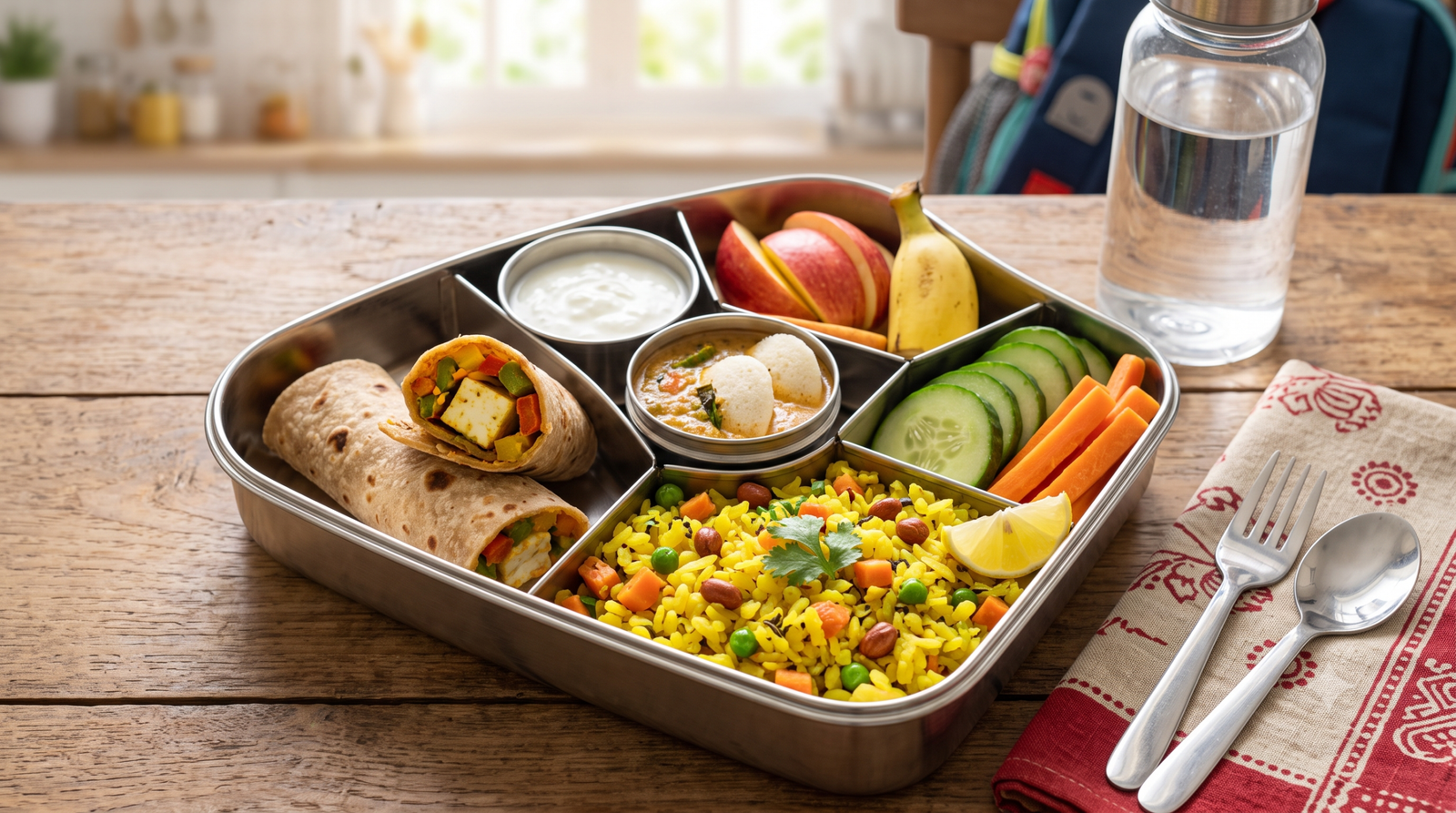
Packing a school lunchbox every morning can feel like a small daily challenge.
Parents want something nutritious. Children want something tasty. And whatever goes into the box also needs to survive a few hours inside a school bag without becoming soggy, messy or boring.
A healthy lunchbox does not need expensive “superfoods” or complicated recipes. Simple Indian foods such as roti, dal, vegetables, curd, fruits, chana, paneer and millets can provide plenty of variety.
The ICMR–National Institute of Nutrition recommends eating from a variety of food groups, including cereals and millets, pulses, vegetables, fruits, nuts and seeds, and milk or curd.
Here are 12 practical lunchbox ideas for school students that balance nutrition, taste and convenience.
1. Vegetable Paneer Roll + Fruit
Spread lightly cooked paneer and vegetables such as carrot, capsicum and onion over a soft whole-wheat roti.
Roll it tightly and cut it into two pieces.
Add a banana, apple or orange on the side.
This lunchbox gives children a combination of cereal, vegetables and a protein-rich filling.
Lunchbox tip: Avoid too much sauce, as it can make the roll soggy.
2. Vegetable Poha + Roasted Chana
Poha is light, quick to prepare and easy for children to eat during a short school break.
Add peas, carrots, peanuts or other vegetables while cooking.
Pair it with a small portion of roasted chana.
A squeeze of lemon can add freshness without needing packaged sauces.
3. Idli + Vegetable Chutney
Soft idlis are one of the easiest foods to carry in a school lunchbox.
Pack three or four small idlis with coconut, tomato or vegetable chutney in a separate leak-proof container.
You can also make vegetable idlis by adding grated carrot, peas or finely chopped greens to the batter.
4. Besan Chilla + Cucumber
Besan chilla can be prepared with onion, tomato, coriander, grated carrot and other vegetables.
Cut the chilla into small triangles so that children can eat it easily.
Add sliced cucumber or a seasonal fruit.
It is particularly useful when you want a break from the usual roti-sabzi combination.
5. Mini Vegetable Uttapam
Mini uttapams are colourful, soft and easy to hold.
Top them with finely chopped tomato, carrot, capsicum, coriander and onion.
Making them in smaller sizes can also make the lunchbox more appealing to younger children.
Pack chutney separately if required.
6. Roti + Dal or Chana Stuffing
Instead of packing separate containers of roti and dal, turn them into an easy-to-eat wrap.
Use cooked chana, moong dal or mildly spiced mashed vegetables as the filling.
Roll everything inside a roti.
This is especially convenient for children who have only 15–20 minutes for their lunch break.
7. Chuda Dahi with Banana
For schools where the lunchbox can be kept reasonably cool, Chuda Dahi can be a simple Odia-inspired option.
Mix flattened rice with curd and banana.
Add a small quantity of nuts or seeds if suitable for the child and permitted by the school.
For food safety, dairy-based foods should not be left warm for long periods; use an insulated lunch bag with an ice pack where necessary.
8. Vegetable Pulao + Curd
Use rice with peas, beans, carrots, cauliflower or other seasonal vegetables.
Keep the spices mild.
A small separate container of curd makes the meal more satisfying.
ICMR-NIN dietary guidance encourages a varied diet containing cereals along with vegetables and other food groups rather than relying heavily on one type of food.
9. Paneer and Vegetable Sandwich
Use whole-wheat bread with lightly seasoned paneer, cucumber, tomato and grated carrot.
Avoid excessive butter, mayonnaise and packaged spreads.
Cut the sandwich into triangles or small squares for younger students.
Pair it with fresh fruit rather than packaged fruit juice.
ICMR-NIN specifically recommends preferring fresh fruit over juice, while WHO also recommends limiting foods and drinks high in free sugars.
10. Sprouts or Chana Chaat
Boiled chana can make a simple, filling lunchbox component.
Add cucumber, tomato, grated carrot and coriander.
For younger children, use well-cooked chickpeas rather than hard or crunchy ingredients.
Lemon can be added just before packing.
If your child finds chaat alone insufficient, combine it with one roti or a small vegetable paratha.
11. Mandia or Ragi Dosa
Odisha has a strong millet tradition, and Mandia or ragi can easily become part of a modern school lunchbox.
Prepare small ragi dosas and serve them with vegetable chutney.
Millets can contribute variety to the cereal portion of the diet, and ICMR-NIN recommends including whole grains and millets as part of a balanced eating pattern.
12. Homemade Vegetable Paratha + Curd
Stuff a whole-wheat paratha with vegetables such as cauliflower, methi, carrot, spinach or peas.
Use only a moderate amount of oil while cooking.
Pack it with curd rather than pickle every day.
You can change the filling throughout the week so that the lunchbox does not become repetitive.
A Simple Lunchbox Formula Parents Can Remember
You don’t need a new recipe every morning.
Think of the lunchbox in four simple parts:
1. Energy food:
Roti, rice, poha, idli, dosa, millet or another cereal.
2. Protein food:
Dal, chana, rajma, paneer, curd, sprouts or other pulses.
3. Vegetable or fruit:
Add at least one colourful vegetable or fresh seasonal fruit.
4. Water:
Send clean drinking water rather than making sugary beverages an everyday habit.
WHO’s current healthy-diet guidance emphasizes adequacy, balance, moderation and diversity, with diets based mainly on minimally processed foods such as whole grains, pulses, vegetables and fruits.
What Should Stay Out of the Everyday Lunchbox?
There is nothing wrong with an occasional treat, but some foods are better kept as occasional choices rather than daily lunchbox staples.
Try to limit:
- Packaged chips
- Sugary drinks
- Cream-filled biscuits
- Chocolate bars
- Instant noodles
- Deep-fried snacks every day
- Highly processed packaged foods
- Excessively salty foods
WHO’s 2026 school-food guidance recommends creating school food environments that favour nutritious foods while reducing foods high in free sugars, salt, saturated fats and trans fats.
Make the Lunchbox Colourful
Children often eat with their eyes first.
A lunchbox containing a brown paratha, orange carrot, green cucumber and yellow banana automatically looks more inviting than a box filled with only one food.
Rotate fruits and vegetables according to season instead of trying to buy expensive imported varieties.
Local foods are often easier on the pocket and perfectly capable of forming part of a nutritious diet.
Don’t Force a “Perfect” Lunchbox
Parents sometimes become worried when children don’t finish everything.
Instead of packing large quantities, begin with portions your child can comfortably finish.
Ask which foods returned untouched and why.
Maybe the roti became hard. Perhaps the fruit was difficult to peel. Maybe the child simply didn’t have enough time.
A successful lunchbox isn’t the one that looks perfect on Instagram.
It’s the one that comes home empty because the child enjoyed eating it.
Healthy eating habits develop gradually, and school years are an important time to introduce children to different fruits, vegetables, pulses, grains and homemade foods.
A little planning can turn the humble school tiffin into one of the healthiest meals of the child’s day.