Why Young Indians Should Start Caring About Heart Health Early
For many young people, heart disease feels like something to worry about after 50.
At 25 or 30, life is more likely to revolve around studies, jobs, deadlines, relationships, EMIs, late-night scrolling and weekend plans than blood pressure or cholesterol.
But heart health does not suddenly begin in middle age.
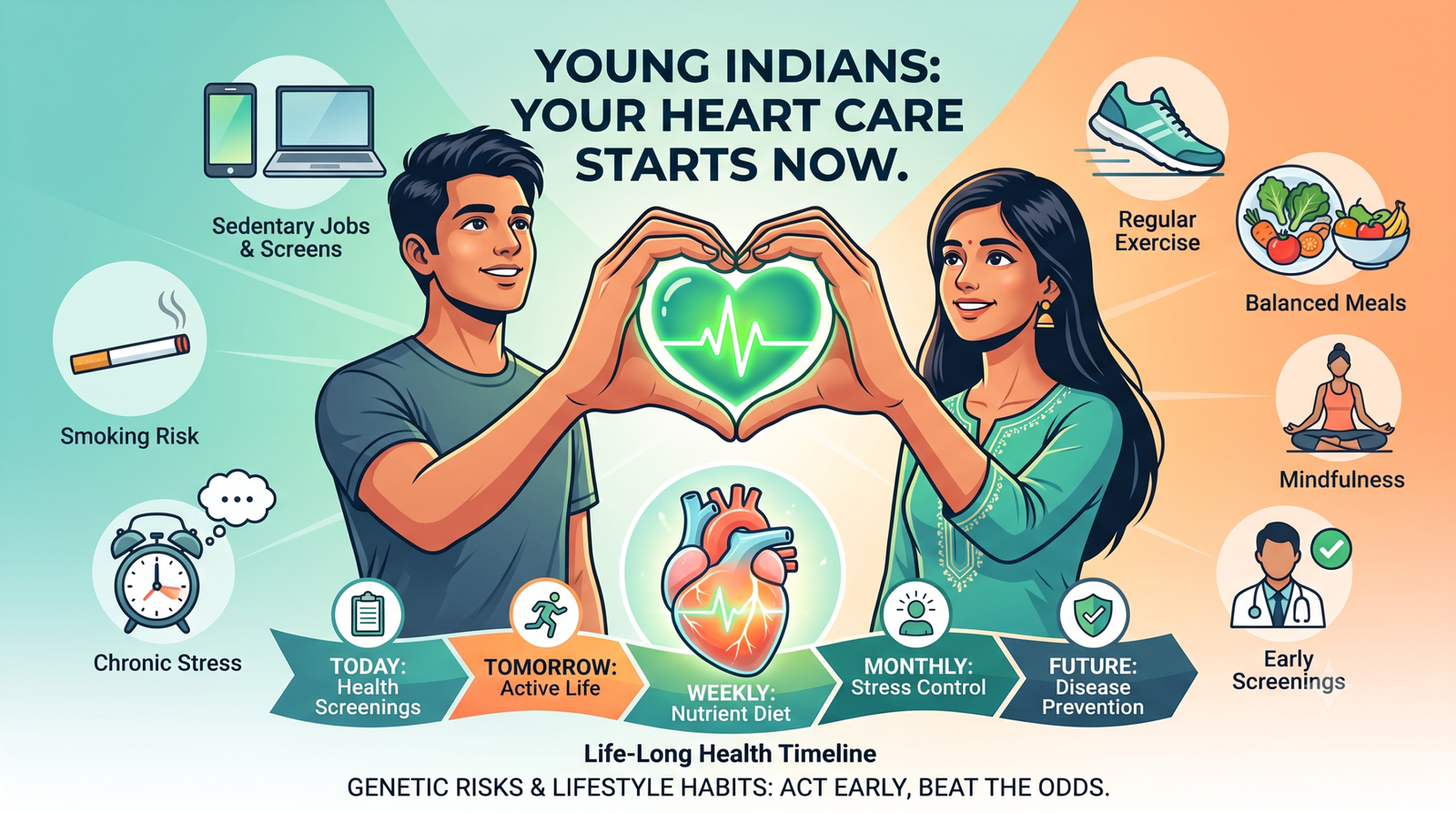
The habits we build in our 20s and 30s—how much we move, what we eat, whether we smoke, how well we sleep and whether we pay attention to basic health checks—can influence cardiovascular health later in life.
And for Indians, starting early deserves particular attention.
Cardiovascular diseases are the leading cause of death globally. WHO estimates that around 19.8 million people died from cardiovascular diseases in 2022, with heart attacks and strokes accounting for the vast majority of those deaths.
In India too, cardiovascular disease represents a major health burden. WHO India notes that cardiovascular diseases account for roughly one-third of deaths in the country, while uncontrolled high blood pressure remains one of the most important risk factors.
That doesn’t mean young Indians should live in fear of heart disease.
It means we should stop treating heart health as an “old person’s problem.”
Heart Disease Usually Doesn’t Begin With a Heart Attack
A heart attack can appear sudden.
The processes contributing to cardiovascular disease, however, can develop quietly over many years.
High blood pressure, raised blood sugar, abnormal cholesterol levels, excess weight, smoking and physical inactivity may increase cardiovascular risk long before someone feels unwell.
WHO points out that underlying blood-vessel disease may sometimes cause no obvious symptoms until a heart attack or stroke occurs.
That is exactly why prevention matters.
You don’t need to wait until something hurts before caring for your heart.
Why Should Indians Pay Attention Earlier?
Evidence suggests that South Asians deserve particular attention when it comes to cardiovascular risk.
Research has found that cardiovascular risk factors can appear relatively early among South Asian adults. A 2026 study highlighted by the American Heart Association found higher levels of several cardiometabolic risk factors among South Asian adults by their mid-40s compared with several other groups studied in the United States.
Earlier Indian research has also documented coronary artery disease occurring at relatively young ages. In one multicentre Indian registry of young patients with coronary artery disease, common risk factors included hypertension, diabetes, tobacco use and family history.
The message isn’t that every young Indian is destined to develop heart disease.
It is that “I’m too young to think about my heart” isn’t a particularly useful health strategy.
1. Know Your Blood Pressure
High blood pressure is often called a silent condition because many people do not feel any different when their blood pressure is elevated.
Yet prolonged uncontrolled hypertension can significantly increase the risk of cardiovascular disease.
WHO India estimates that hundreds of millions of Indian adults live with hypertension and emphasizes regular blood-pressure measurement, early detection and proper treatment.
Getting your blood pressure checked takes only a few minutes.
How often you need testing depends on your readings and individual risk factors, so discuss it with a healthcare professional rather than relying solely on a smartwatch or occasional pharmacy reading.
2. Sitting All Day Is Not the Same as Being Healthy
Many young professionals spend most of the day sitting:
Commute.
Office chair.
Car.
Sofa.
Phone.
Laptop.
Sleep.
Then repeat.
You don’t necessarily need a gym membership to improve your activity levels.
Walking, cycling, swimming, playing a sport, taking stairs and regular workouts all count.
WHO recommends that adults aim for around 150–300 minutes of moderate-intensity aerobic activity each week, or 75–150 minutes of vigorous activity, along with muscle-strengthening exercise on at least two days.
If you’re currently doing almost nothing, don’t become obsessed with hitting the perfect number immediately.
Start walking.
Then walk more.
Consistency is more valuable than an enthusiastic January gym membership that disappears by February.
3. Your Everyday Food Matters More Than Your Occasional Cheat Meal
Heart-healthy eating doesn’t require imported berries, expensive supplements or a refrigerator full of foods recommended by influencers.
An Indian diet can easily include:
- Dal and other pulses
- Vegetables
- Seasonal fruits
- Whole grains
- Millets
- Nuts and seeds
- Curd
- Home-cooked meals
The bigger challenge is often what gets added around those foods—frequent fried snacks, sugary drinks, excessive sweets, heavily processed foods and large quantities of salty packaged snacks.
WHO recommends a diet based largely on minimally processed foods, fruits, vegetables, whole grains and pulses while limiting excess salt, sugars and unhealthy fats.
Traditional foods can absolutely remain part of a healthy diet.
Dalma doesn’t need to disappear.
Neither does roti.
Neither does rice.
The goal is balance, quantity and variety—not declaring one food “good” and another “bad.”
4. Pay Attention to Salt
Many of us associate too much salt only with what we sprinkle over food.
But sodium can also come from pickles, papad, packaged snacks, instant foods, sauces and processed foods.
High sodium intake can raise blood pressure.
WHO recommends adults limit salt intake to less than 5 grams per day, roughly one teaspoon from all dietary sources combined.
That doesn’t mean your food must become tasteless.
Indian kitchens already have hundreds of ways to create flavour using lemon, garlic, ginger, chilli, coriander, cumin, turmeric, mustard and other spices.
5. Tobacco and Your Heart Are a Bad Combination
Heart-health conversations often focus on cholesterol and food while tobacco gets treated mainly as a cancer issue.
But tobacco use is also a major cardiovascular risk factor.
WHO lists tobacco among the most important preventable behavioural risk factors for heart disease and stroke.
That includes more than cigarettes.
Smoking, chewing tobacco and other tobacco products should not be viewed as harmless simply because someone is young or physically fit.
Being able to run five kilometres does not make tobacco safe.
6. Don’t Ignore Blood Sugar and Cholesterol
Young adults sometimes assume diabetes, cholesterol problems and hypertension begin only later in life.
They can occur earlier.
Raised blood glucose and abnormal blood lipids are among the measurable metabolic factors associated with increased cardiovascular risk.
Whether and when you should be screened depends on factors such as age, weight, family history and existing medical conditions.
A doctor can tell you which tests are appropriate.
The important thing is not to avoid a health check simply because you “feel perfectly fine.”
7. Family History Is Information, Not Destiny
Did your father have a heart attack relatively young?
Does diabetes run in the family?
Do several relatives have high blood pressure or cholesterol?
Tell your doctor.
Family history can influence cardiovascular risk, but genes are only one piece of the picture.
You cannot change your parents.
You can influence many of your everyday behaviours.
Knowing your family history should motivate awareness rather than fear.
8. Stress Deserves Attention Too
Modern Indian life can be relentlessly demanding.
Competitive exams.
Uncertain jobs.
Long commutes.
Financial pressure.
Family responsibilities.
Constant notifications.
Poor sleep.
Deadlines that somehow become “urgent” at 10:30 p.m.
Stress itself exists within a much broader web of factors affecting cardiovascular health. WHO identifies stress among the underlying determinants associated with cardiovascular disease.
The answer isn’t to eliminate every stressful situation—that isn’t realistic.
Instead, pay attention to how you respond to stress.
Exercise.
Sleep.
Speak to people.
Take genuine breaks.
Seek professional support when needed.
And don’t use cigarettes, excessive alcohol or constant junk food as your primary coping mechanisms.
You Don’t Need a Perfect Lifestyle
This is where health advice often becomes unrealistic.
Wake up at 5 a.m.
Run 10 kilometres.
Never eat sweets.
Never order food.
Meditate for an hour.
Sleep exactly eight hours.
Drink something green that tastes like a garden.
Most people aren’t going to live like that.
Fortunately, heart health doesn’t require perfection.
It requires better habits repeated often enough.
Walk more.
Eat vegetables more often.
Stop smoking.
Sleep properly.
Check your blood pressure.
Reduce excess salt.
Get appropriate health checks.
Maintain a healthy weight.
Make home-cooked food the normal meal rather than the exception.
Each choice looks small.
Together, they can matter.
What Symptoms Should Never Be Ignored?
Heart problems can present in different ways, and symptoms should not be self-diagnosed from the internet.
WHO lists possible heart-attack symptoms including pain or discomfort in the centre of the chest, discomfort that may involve the arms, shoulder, jaw or back, and symptoms such as shortness of breath, nausea, light-headedness, sweating or pallor.
If you or someone around you develops severe or concerning chest discomfort, difficulty breathing, fainting or other symptoms suggestive of a medical emergency, seek emergency medical care promptly.
Do not assume someone is “too young” to need medical attention.
Start Before Your Heart Forces You To
The best time to care about heart health isn’t after the first alarming blood test.
It isn’t after hypertension is diagnosed.
And it certainly isn’t after a cardiovascular emergency.
It is while you still feel healthy.
Young adulthood is when many lifelong habits are established.
The daily walk you begin at 27 may become normal by 40.
The decision to stop smoking at 30 could be far more valuable than promising yourself you’ll quit later.
Learning to enjoy vegetables, pulses, fruits and simple home-cooked food today is easier than completely rebuilding your lifestyle after a health scare.
Heart health isn’t about becoming afraid of your body.
It is about giving your future self a better chance.
Your heart has already been working for you every second of every day.
Perhaps it’s worth returning the favour.